For many first-time employees, enrolling in a retirement plan is not driven by thoughts of retirement. It is simply another financial decision competing for attention.
Student loan payments, rising housing costs, inflation, childcare expenses, and everyday living costs often make retirement seem too far away to deserve immediate focus.
Ironically, those first few years of employment may have the greatest impact on retirement success.
The habits participants establish early in their careers often remain with them for decades. Starting early allows employees to benefit from compound growth while developing consistent savings behaviors that become increasingly valuable over time.
For employers and retirement service providers alike, this represents an opportunity.
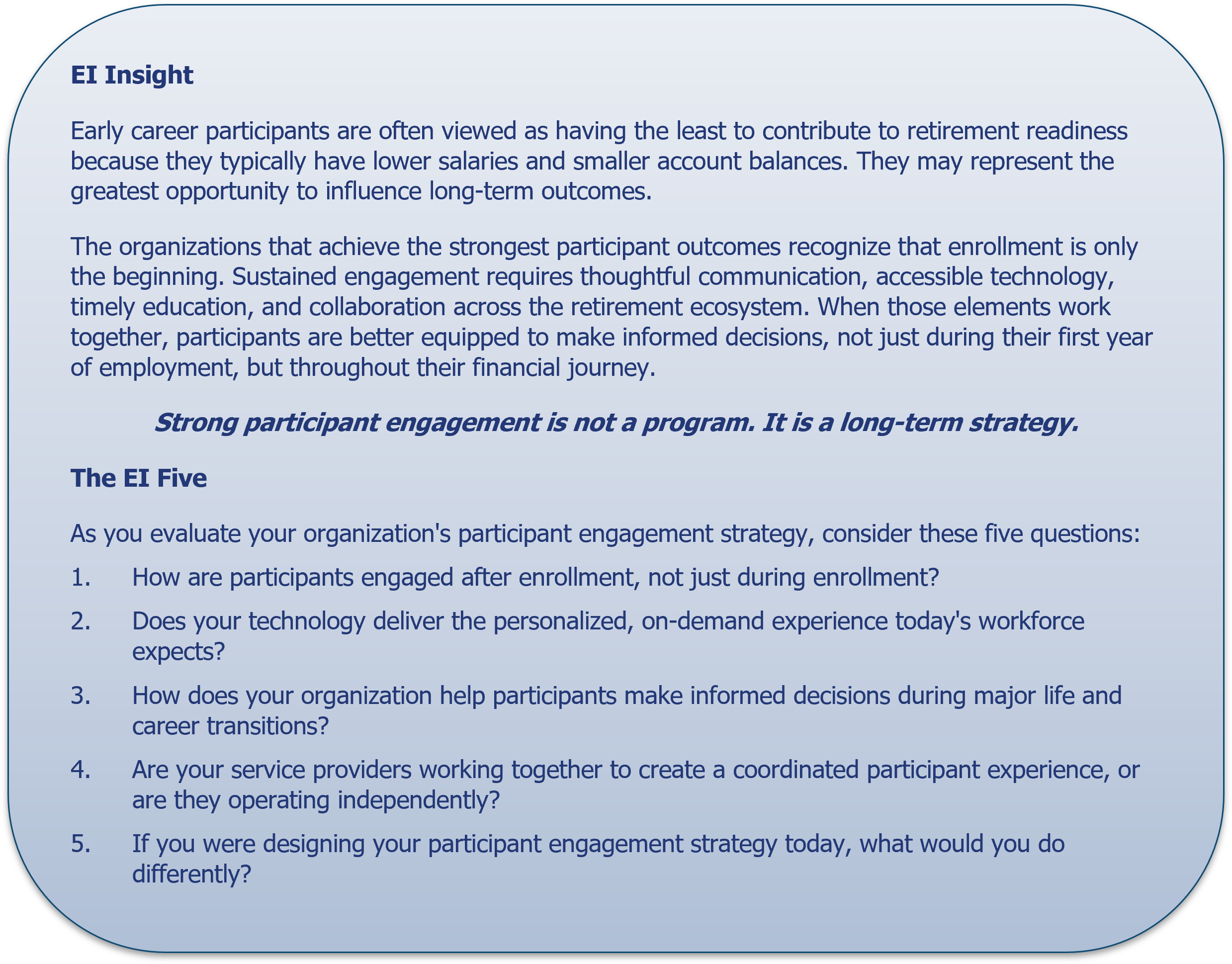
Enrollment should never be viewed as the finish line. Instead, it should mark the beginning of an ongoing participant engagement strategy designed to educate, inform, and build confidence throughout an employee’s career.


Today’s Workforce Expects More
The newest generations entering the workforce have fundamentally different expectations than previous generations.
Career mobility is now common. Many employees expect to work for multiple organizations throughout their careers, making retirement savings portability more important than ever.
Every job transition creates important financial decisions; from deciding whether to leave assets in a former employer’s plan to rolling them into a new plan or IRA. Each choice has long-term implications.
At the same time, participants expect communication that is available on demand, mobile-friendly, personalized, easy to understand, and relevant to their current financial situation.
Traditional enrollment meetings and quarterly statements remain valuable, but they are no longer enough to sustain participant engagement.
Education Is Most Effective When It Is Relevant
Many participants begin saving without fully understanding the retirement plan they have joined.
Questions surrounding employer matching, investment diversification, Roth versus traditional contributions, vesting schedules, target-date funds, and retirement plan loans are common among new participants.
Providing more information does not always change behavior.
Providing the right information at the right time often does.
Financial education becomes far more meaningful when it aligns with milestones such as a first paycheck, a promotion, marriage, purchasing a home, starting a family, or changing jobs.
There is NO Universal Offer
One of the first financial decisions participants face is choosing between traditional pre-tax and Roth contributions.
For some younger workers, Roth contributions may provide meaningful long-term advantages because they are often in lower tax brackets and have decades of potential tax-free growth ahead.
Others may benefit more from traditional pre-tax contributions based on their individual circumstances.
The objective is not to steer participants toward one option, but to provide the education and tools needed to make informed decisions.
Time is a Younger Investor’s Greatest Advantage
Many first-time investors equate market volatility with investment failure.
Younger participants possess one advantage that cannot be recreated later in life: time.
Helping participants understand diversification, long-term investing, and appropriate risk management builds confidence while encouraging disciplined investment behavior.
Financial wellness is not about eliminating risk.
It is about understanding it.
Technology Is Reshaping the Participant Experience
Artificial intelligence, digital planning tools, and personalized educational experiences are making retirement information more accessible than ever.
Participants increasingly expect immediate answers to questions such as:
- Should I increase my contribution after receiving a raise?
- Am I saving enough?
- What happens if I change jobs?
- Should I consolidate retirement accounts?
- What is the difference between Roth and traditional pre-tax contributions?
Used responsibly, AI can enhance participant education while allowing retirement professionals to focus on conversations requiring experience, judgment, and personal guidance.
Technology should complement; not replace the human relationships that remain central to retirement planning.
Collaboration Drives Better Outcomes
No single organization owns the participant’s relationship.
Employers, TPAs, Advisors, Recordkeepers, Plan Consultants, and Technology Providers each contribute unique expertise that influences participant success.
When these organizations work together, participants experience better communication, stronger education, more informed decision-making, greater confidence, and improved retirement readiness.
Participants should experience one coordinated retirement ecosystem, not a collection of independent service providers.
Conclusion
Retirement success is rarely determined by one major financial decision.
More often, it is built through hundreds of small decisions made consistently over time.
The first years of employment provide a unique opportunity to establish the habits, confidence, and financial behaviors that influence retirement outcomes for decades. Organizations that invest in participant engagement early are doing more than helping employees prepare for retirement. They are creating a foundation for informed decision-making that can benefit participants throughout their financial journey.