
Executive Summary
Across the industry, there is a longstanding assumption that consultants are inherently more expensive than
full-time employees (FTEs). At a glance, that conclusion appears sound, consulting rates are typically higher than the equivalent cost of internal staff.
However, when viewed more holistically, factoring in time, risk, and delivery outcomes, that assumption does not always hold. In certain situations, consultants can represent the more economical choice.
For budget owners, the more relevant question is not “What does this resource cost?” but “What is the total cost of delivering the outcome?”
“Cost is not just what you pay, it is what you delay, redo, or get wrong.”
WHITEPAPER
May 14, 2026

Rethinking the Cost Comparison
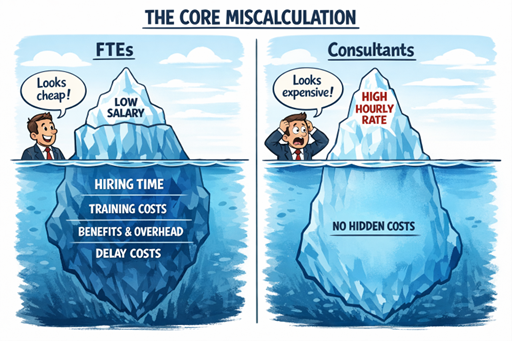
Visible costs are only part of the equation. Most of the economic impact is often below the surface.
Most cost comparisons between consultants and full-time employees focus on what is immediately visible, salary versus hourly rate. But like an iceberg, the largest cost drivers are often hidden beneath the surface.
These “below-the-line” costs include hiring time, training and ramp-up, benefits and overhead, and the cost of delay when work does not progress. Less visible still, but often more consequential, are the costs associated with rework, misaligned decisions, and the challenge of redeploying resources once an initiative is complete.
Individually, these factors may appear manageable. Collectively, they can materially exceed the visible cost difference between a consultant and an FTE.
When these hidden costs are accounted for, the economic comparison shifts, from a focus on rate to a more accurate view of total cost.
Situations Where Consultants May Be the Lower-Cost Option
- Time-Bound Initiatives
For efforts with a defined endpoint, such as system upgrades, conversions, or regulatory implementations, consultants provide a flexible model. Costs align directly to the duration of the work, avoiding the need to carry excess capacity after completion.
- Specialized or Hard-to-Find Skills
Certain capabilities, particularly in legacy platforms and niche systems common in the retirement industry, are difficult to source and take time to build internally.In these situations, the primary cost driver is not compensation, it is time to proficiency. Experienced consultants reduce ramp time and help avoid costly missteps.
- Programs Under Time Pressure
When timelines begin to slip, delay quickly becomes a dominant cost factor. Extended vendor engagements, duplicated effort, and missed milestones all contribute to increased spend.External support can help restore direction and momentum, often reducing total cost by shortening the duration of the issue.
- High-Impact Decisions
Decisions related to architecture, vendor selection, or platform strategy carry long-term implications and are not easily reversed.Independent validation in these moments can provide additional confidence and help avoid outcomes that are far more expensive than the advisory support itself.
- Fluctuating Workloads
Many organizations operate in cycles of peak demand followed by periods of relative stability. Staffing permanently for peak conditions can create inefficiencies over time.Consultants allow organizations to scale resources in alignment with demand, helping maintain cost discipline without constraining delivery.
- Capability Build-Outs
When establishing new capabilities, such as data platforms, automation frameworks, or DevOps practices, the greatest value is often in initial design and implementation.Consultants can accelerate this phase and support knowledge transfer, enabling internal teams to sustain the capability without long-term overstaffing.
- Hiring ConstraintsRecruiting for specialized roles is often both time-consuming and uncertain. Even successful hires require time to become fully effective.Consultants help bridge this gap, ensuring progress continues while longer-term staffing strategies are executed.
Where FTEs Remain the Right Choice
Full-time employees remain the most effective option for work that is ongoing, predictable, and deeply embedded in the organization. They provide continuity, preserve institutional knowledge, and support long-term operational stability. For many core functions, this makes them the more economical choice over time.
A Balanced Decision Framework
In practice, the decision is rarely binary. Instead, it is about aligning the resource model to the nature of the work.
Consultants tend to be more cost-effective when:
- The work is time-bound
- Skills are specialized or scarce
- Speed is critical
- Demand is variable
- Independent perspective is valuable
FTEs tend to be more cost-effective when:
- Work is ongoing and stable
- Skills are readily available
- Long-term continuity is important
Closing Prespective
Effective cost management is not simply about minimizing visible expenses, it is about managing total economic impact.
Organizations that consistently deliver are those that balance speed, quality, and risk. In that context, consultants are not inherently a premium cost, nor are they a universal solution. They are one of several tools available to budget owners to navigate complex and evolving demands.
Used thoughtfully, they can help control cost, reduce risk, and support better outcomes.
About Enterprise Iron
Enterprise Iron advises and delivers complex transformation programs across the retirement and financial services industry. We specialize in stepping into high-stakes initiatives, where timelines are tight, risks are elevated, and outcomes matter.
Our teams bring deep, hands-on experience across platform modernization, data initiatives, and large-scale program execution. We focus on restoring momentum, improving decision quality, and delivering results without adding unnecessary overhead.
Take the Next Step
When cost, speed, and risk are all in play, the question is not just who is cheaper, it’s who will deliver the right outcome.
Enterprise Iron helps organizations apply the right expertise at the right time, whether accelerating a critical initiative, addressing capacity gaps, or providing independent perspective on key decisions.
If you are under pressure to deliver more efficiently without compromising outcomes, We Can Help!