
Executive Summary
Large enterprise system transformations, particularly financial system upgrades, ERP modernizations, and complex data platform implementations, frequently encounter a predictable governance failure mode: escalating testing cycles driven by stakeholder risk perception rather than defined risk.
While additional testing is often intended to reduce exposure, uncontrolled expansion of testing scope often produces the opposite effect. Decision cycles slow, defect remediation is delayed, and delivery timelines extend while teams debate hypothetical risks rather than addressing confirmed issues.
Unbounded testing does not reduce risk; it delays resolution and extends exposure to known defects.
WHITEPAPER
April 15, 2026

In many cases, the issue is not technical capability. Implementation teams may include experienced engineers, platform specialists, and industry experts with deep knowledge of the systems being deployed. The underlying challenge is typically a misalignment between technical execution and stakeholder risk perception.
When this dynamic emerges, organizations can enter a state of governance paralysis, a cycle in which testing activity continues to expand without materially improving system assurance or delivery progress.
This paper outlines a practical governance framework that converts stakeholder risk concerns into structured testing strategy. By aligning testing activities with clearly defined risks, establishing measurable sufficiency criteria, and introducing disciplined governance controls, organizations can maintain strong assurance standards while protecting delivery momentum.
Industry Reality: Why Testing Escalation is Increasing
Enterprise transformation programs have grown significantly more complex over the past decade. Financial system modernization, ERP upgrades, and large-scale data platform initiatives now involve broader stakeholder groups, tighter regulatory scrutiny, and increasingly interconnected systems.
Industry research consistently shows that governance challenges, not technical limitations are among the most common drivers of transformation delays.
Several structural trends are contributing to this dynamic:
- Large transformation programs now involve finance, technology, compliance, audit, and operations stakeholders, each with distinct risk concerns.
- Financial reporting and regulatory scrutiny have increased the perceived consequences of system errors.
- Organizations often lack clearly defined testing governance frameworks, making it difficult to determine when validation efforts are sufficient.
In the absence of structured governance, stakeholders frequently respond to perceived risk by requesting additional testing cycles. While well-intentioned, this behavior can unintentionally slow delivery progress and delay resolution of known issues.
Organizations must therefore balance risk management with disciplined delivery governance to ensure transformation programs continue moving forward.
When Testing Expansion Becomes a Governance Problem
Across complex system implementations, it is common for organizations to increase testing activity when stakeholders perceive heightened operational or financial risk. While this instinct is understandable, unmanaged expansion of testing cycles often creates unintended consequences.
Without a structured governance framework, testing discussions often shift from validating known risks to exploring hypothetical failure scenarios. Stakeholders may request additional validation without clearly defining failure modes, measurable objectives, or completion criteria.
As testing expands, delivery teams allocate increasing capacity toward validation rather than resolving confirmed defects. Decision cycles lengthen, technical momentum slows, and implementation timelines begin to erode.
Over time, this pattern reinforces governance paralysis, testing expands while meaningful delivery progress slows. Organizations experiencing testing escalation often exhibit several recognizable warning signs:
- Repeated requests for additional testing without clearly defined failure scenarios
- Reopening previously completed validation cycles
- Expansion of testing scope without retiring earlier requirements
- Circular debate regarding hypothetical system risks
- Preference for anecdotal external advice over platform expertise
In most cases, these behaviors are driven by legitimate organizational concerns rather than technical deficiencies. Stakeholders may be responding to financial reporting risk, regulatory oversight, or limited visibility into system architecture and testing methodology.
However, without disciplined governance structures, these concerns can unintentionally lead to unbounded testing cycles that delay remediation and extend delivery timelines.
The Enterprise Iron Risk-Aligned Testing Framework
Organizations can break the cycle of testing escalation by introducing governance mechanisms that align testing activity directly with defined risks.
Enterprise Iron Risk-Aligned Testing Governance Framework provides a practical model for ensuring testing efforts remain targeted, measurable, and efficient.
- Establish Risk-to-Test Traceability
- Implement a Tiered Testing Strategy
- Define Test Sufficiency Criteria
- Separate Technical vs Confidence Testing
1. Establish Risk-to-Test Traceability
Every test case should correspond to a clearly defined risk scenario. Testing activities should not exist in isolation but should instead map directly to potential failure modes and business impacts.
Organizations can introduce a structured risk traceability matrix linking each risk to its corresponding validation control, evidence, and exit criteria. This approach shifts governance conversations away from testing volume and toward testing relevance.
When stakeholders understand precisely which risks are being mitigated by each test, discussions become more focused and productive.
2. Implement a Tiered Testing Strategy
Not all testing serves the same purpose, and without structure, validation efforts can expand without clear prioritization. Testing efforts should be organized into clearly idefined tiers aligned with implementation risk.
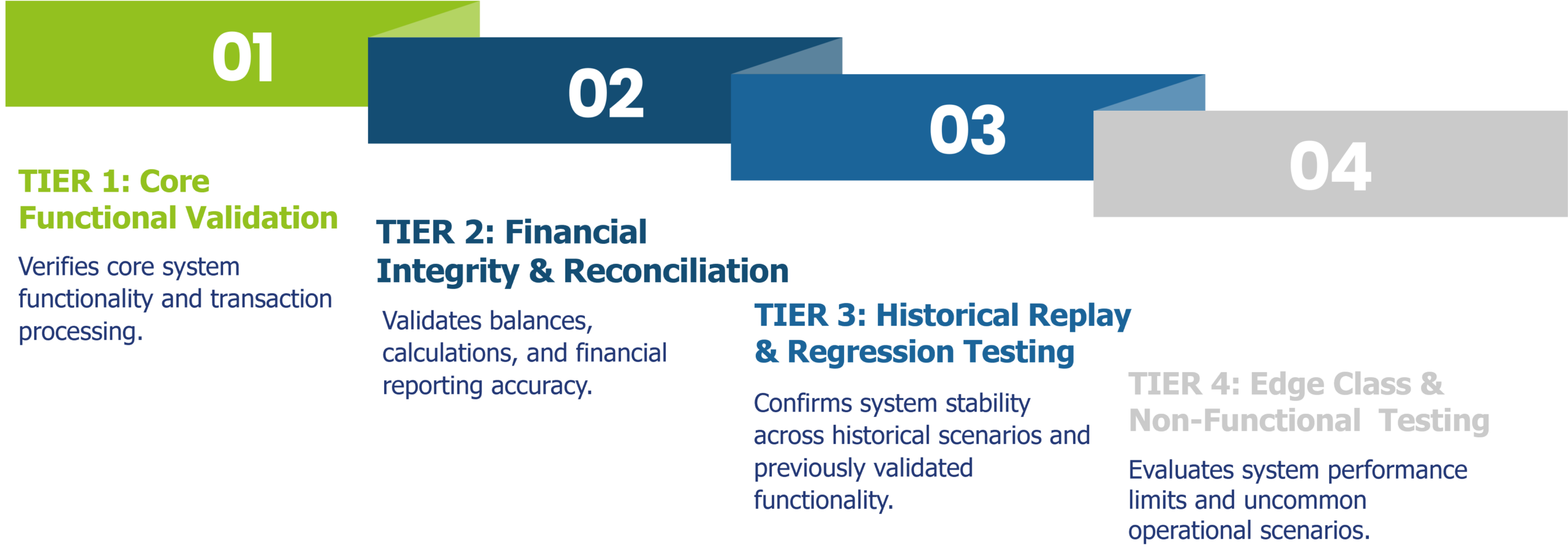
Mapping testing requests to these tiers ensures validation efforts remain purposeful and aligned with governance objectives.
3. Define Test Sufficiency Criteria
Testing must have a clearly defined endpoint. Without explicit sufficiency criteria, validation efforts will expand indefinitely.
Organizations should establish measurable indicators that signal when testing objectives have been achieved. These indicators may include stabilization of defect discovery rates, reconciliation results within defined tolerances, absence of new defect categories, and a downward trend in open issue backlogs.
Establishing these criteria in advance ensures stakeholders understand what constitutes sufficient validation.
4. Seperate Technical Testing from Confidence Testing
Not all testing serves the same objective. In practice, validation efforts fall into two distinct categories:
-
-
- Defect Detection Testing focuses on identifying and resolving technical failures within the system.
- Confidence Demonstration Testing provides assurance to stakeholders that the system has been sufficiently validated.
Both play an important role. However, confidence driven testing must be explicitly bounded to prevent unnecessary expansion of validation cycles and erosion of delivery capacity. When organizations explicitly distinguish between these testing objectives, they can maintain strong governance oversight while protecting delivery capacity.
-
What Successful Programs Look Like
Organizations that implement structured testing governance often experience significant improvements in delivery stability and stakeholder alignment.
By linking testing activities directly to defined risks and establishing measurable completion criteria, teams can maintain strong assurance standards while preserving implementation momentum.
Successful programs typically demonstrate several characteristics:
- Clear traceability between risks and validation activities
- Faster defect remediation cycles
- Reduced decision paralysis during testing phases
- Stabilized delivery timelines
- Increased stakeholder confidence in implementation outcomes
These outcomes reflect the benefits of shifting from reactive testing expansion to disciplined governance frameworks.
Why Governance Discipline Matters
As enterprise organizations modernize financial systems and implement complex technology platforms, governance complexity will continue to increase. Programs now involve diverse stakeholders with varying perspectives on risk, compliance, and operational stability.
Without structured testing governance, these perspectives can unintentionally create bottlenecks that slow transformation progress and increase implementation costs.
Organizations that adopt disciplined testing frameworks are better positioned to maintain both system assurance and delivery velocity, ensuring transformation programs achieve their intended outcomes.
About Enterprise Iron
Enterprise Iron provides advisory and implementation leadership for complex enterprise transformations, including ERP modernization, financial system upgrades, and large-scale data platform initiatives. We help organizations stabilize delivery, align governance, and implement structured frameworks that drive predictable outcomes.
Take the Next Step
Complex transformations require more than technical execution; they require disciplined governance and clear alignment between risk and delivery. Enterprise Iron specializes in helping organizations overcome testing escalation, governance gridlock, and delivery slowdown.
If your program is losing momentum, we can help you restore control and move forward with confidence.
Explore case studies highlighting our real-world impact at enterpriseiron.com/case-studies or connect with us at info@enterpriseiron.com.