
Executive Summary
The United States Social Security system and the Australian Superannuation system represent fundamentally different approaches to providing national retirement income security. Social Security operates as a pay-as-you-go social-insurance program in which payroll taxes collected from current workers finance benefits for current retirees. By contrast, Australia’s Superannuation system is a compulsory, defined-contribution framework in which retirement assets are accumulated in individually owned and invested accounts.
The U.S. Social Security system is under increasing long-term financial strain, driven primarily by demographic trends, most notably declining birth rates and rising life expectancy. According to the 2024 Social Security Trustees Report, the Old-Age and Survivors Insurance Trust Fund is projected to exhaust its reserves by 2033. Upon depletion, incoming payroll tax revenues would be sufficient to cover only approximately 75–79 percent of scheduled benefits, resulting in an automatic benefit reduction of roughly 21–25 percent in the absence of legislative intervention.
WHITEPAPER
February 16, 2026

Australia’s Superannuation model, while structurally more sustainable due to its asset-backed design, exposes participants to investment, market, and economic-cycle risks that are largely absent from traditional defined-benefit social insurance systems. Any serious consideration of transitioning the United States from a pay-as-you-go model toward a Superannuation-style system must therefore address significant challenges related to transition financing, sequencing, risk allocation, and intergenerational equity.
The below table summarizes the core structural differences between the U.S. Social Security system and the Australian Superannuation system.
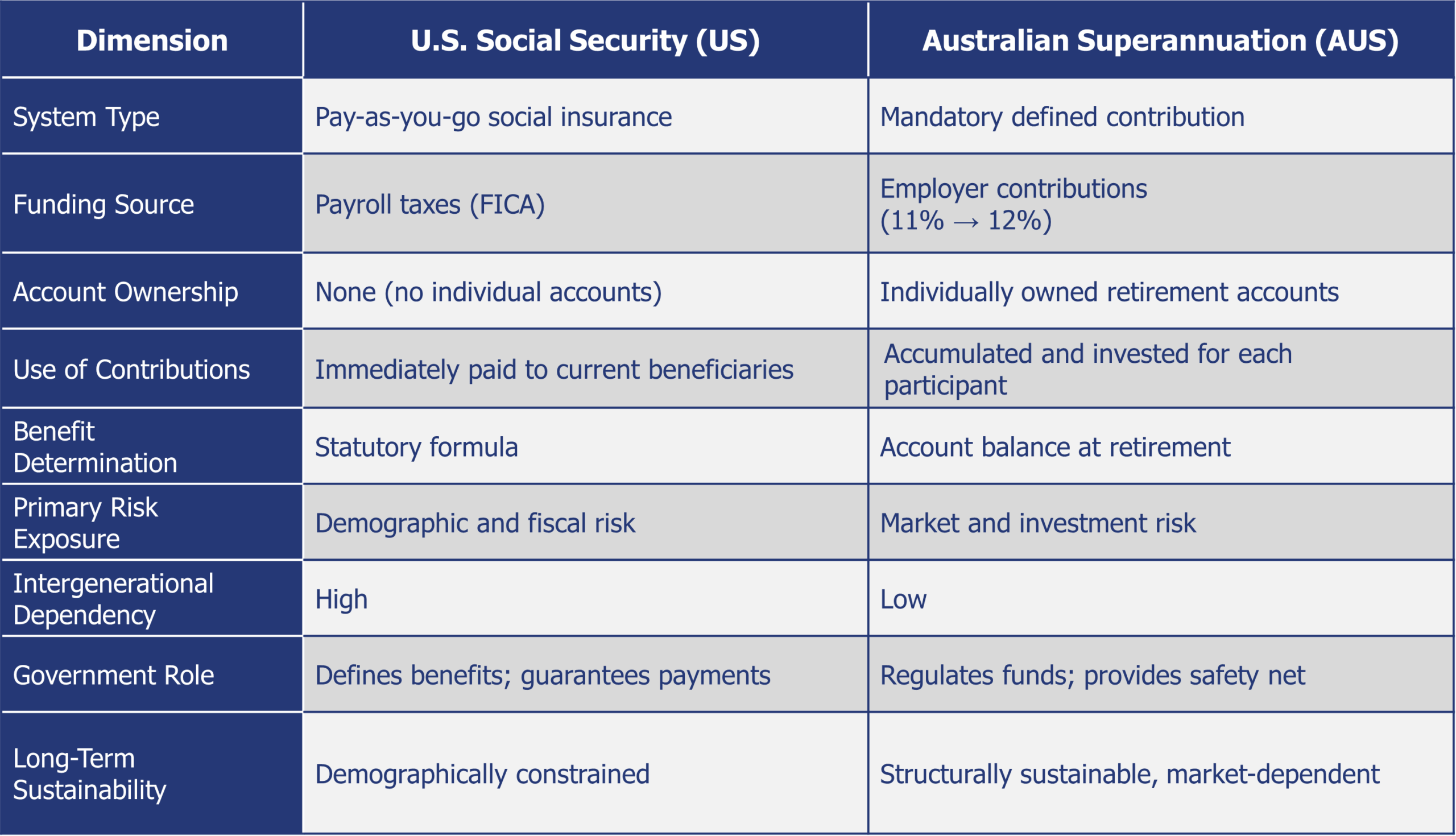
This paper examines the structural differences between the two systems, evaluates their respective strengths and vulnerabilities, and outlines a phased transition framework intended to enhance long-term solvency while protecting current and future retirees.
System Overview and Structural Differences in Practice
While the above table provides a high-level structural comparison of the U.S. Social Security system and the Australian Superannuation system, a closer examination of each system’s operational mechanics highlights how these structural differences translate into materially different financial outcomes, risk exposures, and long-term sustainability profiles. This section explains how each system functions in practice and how its design choices shape long-term performance.
The U.S. Social Security System
The U.S. Social Security system is a statutory, pay-as-you-go social-insurance program funded primarily through payroll taxes collected under the Federal Insurance Contributions Act (FICA). Contributions made by today’s workers are not accumulated or invested in individual accounts. Instead, they are used primarily to finance benefit payments to current retirees and other beneficiaries.
Any temporary excess of payroll tax revenues over benefit payments is credited to the Social Security Trust Funds and invested exclusively in special-issue U.S. Treasury securities. These securities represent claims on future general revenues rather than independently managed, market-traded financial assets. As a result, the Trust Funds do not function as a traditional investment portfolio capable of generating market-based returns.
Benefits under Social Security are determined by statutory formulas based on lifetime earnings, wage indexing, and claiming age. Benefit levels are defined by law rather than by contribution performance or investment returns. While this structure provides predictability and insulation from market volatility at the individual level, it creates a direct dependency on demographic conditions and workforce growth at the system level.
As fertility rates decline and life expectancy continues to increase, the ratio of workers to beneficiaries continues to fall. This demographic shift places increasing strain on a system that relies on current payroll taxes rather than asset accumulation to finance future obligations.
The Australian Superannuation System
Australia’s Superannuation system operates as a mandatory, employer-funded defined-contribution retirement framework. Employers are required to contribute a legislated percentage of employee earnings, currently 11 percent, scheduled to rise to 12 percent by 2025, into Superannuation accounts owned by individual workers.
Contributions are deposited into individually owned accounts and invested on behalf of participants by licensed Superannuation funds operating under a regulated fiduciary framework. Account balances grow over time through a combination of employer contributions and investment returns, with retirement outcomes directly linked to accumulated assets at retirement.
Unlike Social Security, the Superannuation system is fully funded at the individual level and does not rely on intergenerational transfers to pay benefits. This design significantly reduces exposure to demographic risk and improves long-term fiscal sustainability. However, it shifts a greater share of risk to individuals in the form of market volatility, investment performance variability, and timing risk associated with retiring during adverse market conditions.
The Australian government plays a supervisory role by regulating contribution requirements, fund governance, and disclosure standards, while also providing a separate, means-tested public pension as a safety net. Superannuation therefore functions as the primary retirement savings mechanism rather than a guaranteed, government provided income program.
Social Security Solvency Challenges and Driving Forces
The long-term financial outlook for the U.S. Social Security system reflects structural pressures that are unlikely to self-correct under current policy. Unlike funded retirement systems, Social Security’s pay-as-you-go design makes it highly sensitive to demographic and labor-force trends. As these trends shift unfavorably, the system’s ability to meet scheduled benefit obligations deteriorates.
Projected Trust Fund Depletion
According to the 2024 Social Security Trustees Report, the Old-Age and Survivors Insurance Trust Fund is projected to exhaust its reserves by 2033. Once depleted, Social Security would no longer be able to pay full scheduled benefits using accumulated reserves. At that point, benefit payments would be limited to incoming payroll tax revenues.
Under current law, Trust Fund depletion would trigger an immediate reduction in payable benefits. Current projections indicate that post-depletion revenues would be sufficient to cover only approximately 75 to 79 percent of scheduled benefits. In the absence of legislative intervention, this shortfall would result in an automatic, across-the-board benefit reduction of roughly 21 to 25 percent for all beneficiaries, regardless of income level or retirement timing.
Structural Drivers of Insolvency
The projected depletion of Social Security’s Trust Fund is driven by several reinforcing structural factors:
- Declining birth rates, which reduce the number of future workers contributing payroll taxes
- Increased life expectancy, extending the duration of benefit payments
- A shrinking worker-to-beneficiary ratio, weakening the revenue base relative to obligations
- A funding model reliant on payroll taxation, with limited capacity to generate investment returns
Together, these dynamics place increasing strain on a system designed for a demographic environment that no longer exists. Without reform, the gap between scheduled benefits and available financing is projected to widen over time.
Strengths and Vulnerabilities of the Australian Superannuation Model
Australia’s Superannuation system offers several structural advantages relative to pay-as-you-go social insurance models. It is largely insulated from demographic pressures, relies on asset-backed funding, and provides individually owned, portable accounts. Participants benefit from exposure to long-term market growth, enhancing the system’s sustainability at a macro level.
However, the model introduces market-related risks, including:
- Potential declines in account value during recessions
- Sequence-of-returns risk near retirement
- Fund mismanagement or concentration of assets
- Inflation risk affecting real purchasing power
- System-level stress during prolonged economic downturns
Balancing these strengths and risks is critical for understanding how such a model could complement or replace Social Security in the U.S.
Challenges in Transitioning from Social Security to Superannuation in the United States
Transitioning from a pay-as-you-go system to a funded defined-contribution framework presents significant economic and political challenges.
Core transition challenge: Redirecting payroll taxes into individual accounts reduces revenues available to pay existing Social Security beneficiaries while obligations remain unchanged. This creates a large funding gap, potentially reaching trillions of dollars over several decades.
Additional Challenges:
- Intergenerational equity concerns
- Tax policy and revenue implications
- Administrative overhaul requirements
- Participant education and financial literacy needs
- Political polarization and reform resistance
Phased Transition Framework from Social Security to Superannuation
Transitioning from a pay-as-you-go retirement system to a funded, defined contribution framework cannot occur abruptly without imposing significant economic disruption and intergenerational inequities. Existing Social Security beneficiaries depend on uninterrupted benefit payments, while current workers would be unable to simultaneously finance legacy obligations and fully fund individual retirement accounts without transitional support mechanisms. As a result, any viable reform must balance system stability, fiscal responsibility, and participant protection over an extended time horizon.
The graphic below presents a phased transition framework designed to gradually introduce a Superannuation-style retirement system while preserving Social Security’s ability to meet existing obligations. The framework emphasizes sequencing rather than replacement, allowing institutional capacity, funding structures, and participant behavior to adjust incrementally.

The phased approach outlined above reduces transition risk by maintaining Social Security as the primary benefit mechanism during the early stages while progressively expanding asset-based retirement savings for younger cohorts. By overlapping the two systems for an extended period, the model allows payroll tax redirection, regulatory development, and financial literacy efforts to scale in tandem with declining legacy obligations. Over time, this structure enables Social Security to evolve into a targeted safety net, while a fully funded Superannuation framework becomes the primary source of retirement income, reducing long-term exposure to demographic pressures without abrupt benefit disruptions.
Conclusion
The U.S. Social Security system faces structural challenges unlikely to resolve without reform. Australia’s Superannuation system demonstrates how a funded, asset-based approach can enhance long-term sustainability, albeit with greater exposure to market risk at the individual level.
A carefully designed, phased transition offers a path to modernizing U.S. retirement security while balancing solvency, intergenerational equity, and participant protection. By combining the strengths of both systems, policymakers may construct a more resilient and sustainable retirement framework for future generations.
About Enterprise Iron
Enterprise Iron is a consulting firm with more than 20 years of deep expertise in operations, compliance, and technology transformation across the financial services and government sectors. While widely recognized for our leadership in the retirement industry, our team of seasoned subject-matter experts partners with public and private sector organizations of all sizes to navigate modernization initiatives, complex integrations, and evolving regulatory requirements. We deliver independent, practical guidance tailored to each client’s unique operational and strategic challenges.
Explore case studies highlighting our real-world impact at enterpriseiron.com/case-studies. To learn how our expertise can help strengthen your organization, contact us at info@enterpriseiron.com or connect with us on LinkedIn to start the conversation.